
13 KiB
WhisperLiveKit
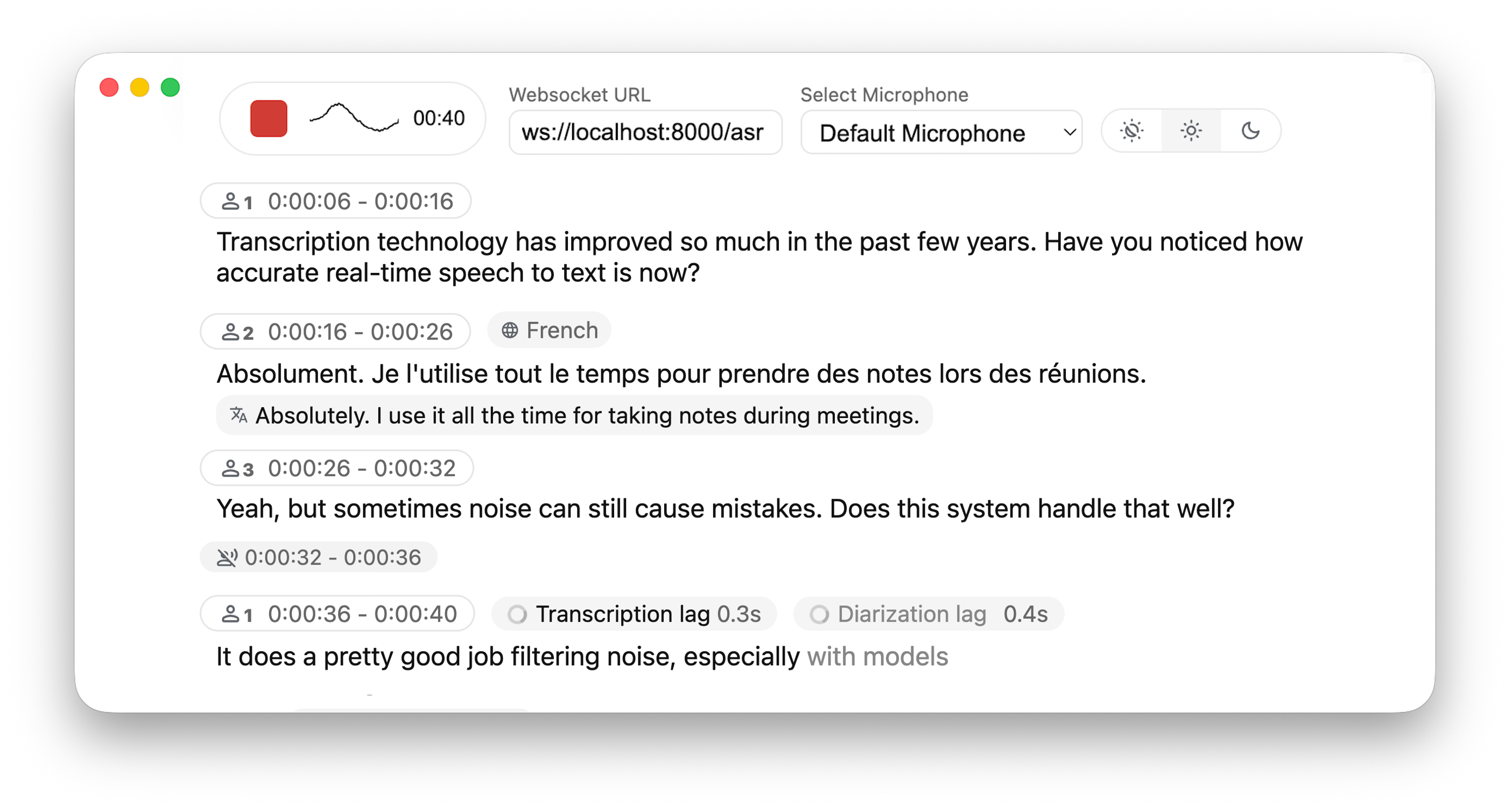
Real-time, Fully Local Speech-to-Text with Speaker Identification



Real-time transcription directly to your browser, with a ready-to-use backend+server and a simple frontend.
Powered by Leading Research:
- Simul-Whisper/Streaming (SOTA 2025) - Ultra-low latency transcription using AlignAtt policy
- NLLW (2025), based on distilled NLLB (2022, 2024) - Simulatenous translation from & to 200 languages.
- WhisperStreaming (SOTA 2023) - Low latency transcription using LocalAgreement policy
- Streaming Sortformer (SOTA 2025) - Advanced real-time speaker diarization
- Diart (SOTA 2021) - Real-time speaker diarization
- Silero VAD (2024) - Enterprise-grade Voice Activity Detection
Why not just run a simple Whisper model on every audio batch? Whisper is designed for complete utterances, not real-time chunks. Processing small segments loses context, cuts off words mid-syllable, and produces poor transcription. WhisperLiveKit uses state-of-the-art simultaneous speech research for intelligent buffering and incremental processing.
Architecture
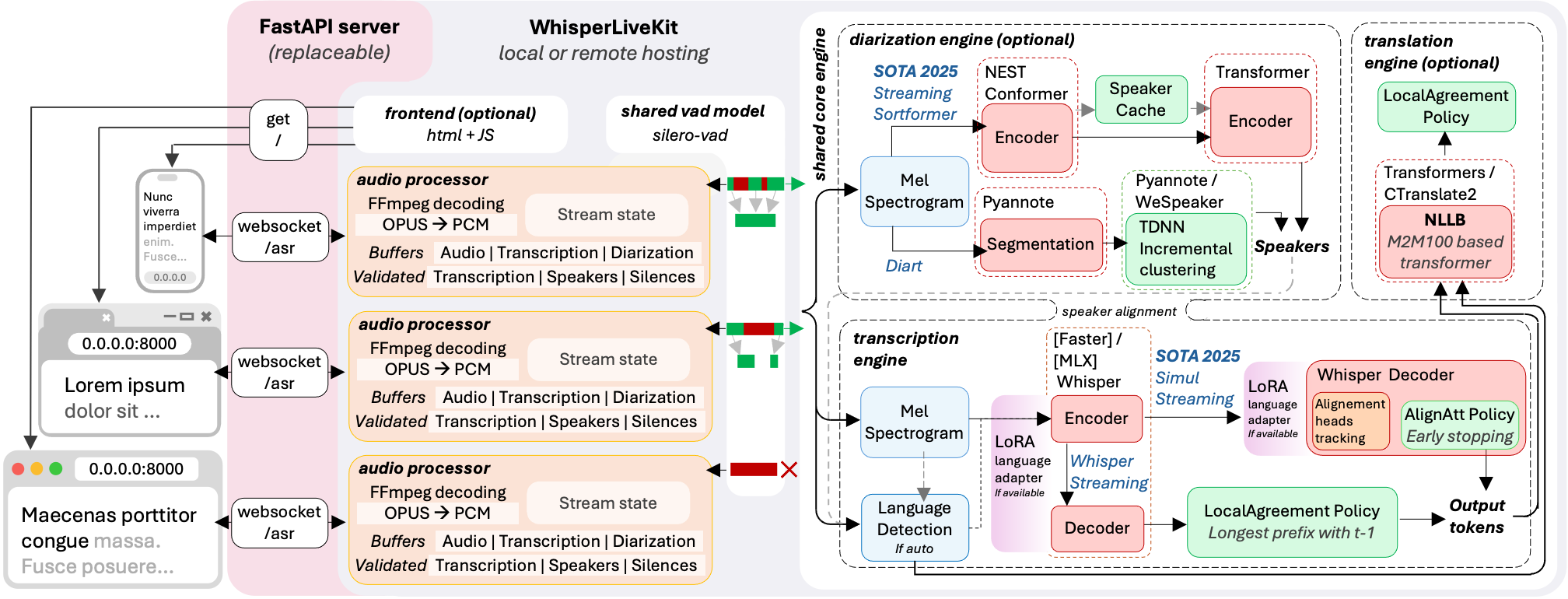
The backend supports multiple concurrent users. Voice Activity Detection reduces overhead when no voice is detected.
Installation & Quick Start
pip install whisperlivekit
You can also clone the repo and
pip install -e .for the latest version.
Quick Start
-
Start the transcription server:
whisperlivekit-server --model base --language en -
Open your browser and navigate to
http://localhost:8000. Start speaking and watch your words appear in real-time!
- See tokenizer.py for the list of all available languages.
- For HTTPS requirements, see the Parameters section for SSL configuration options.
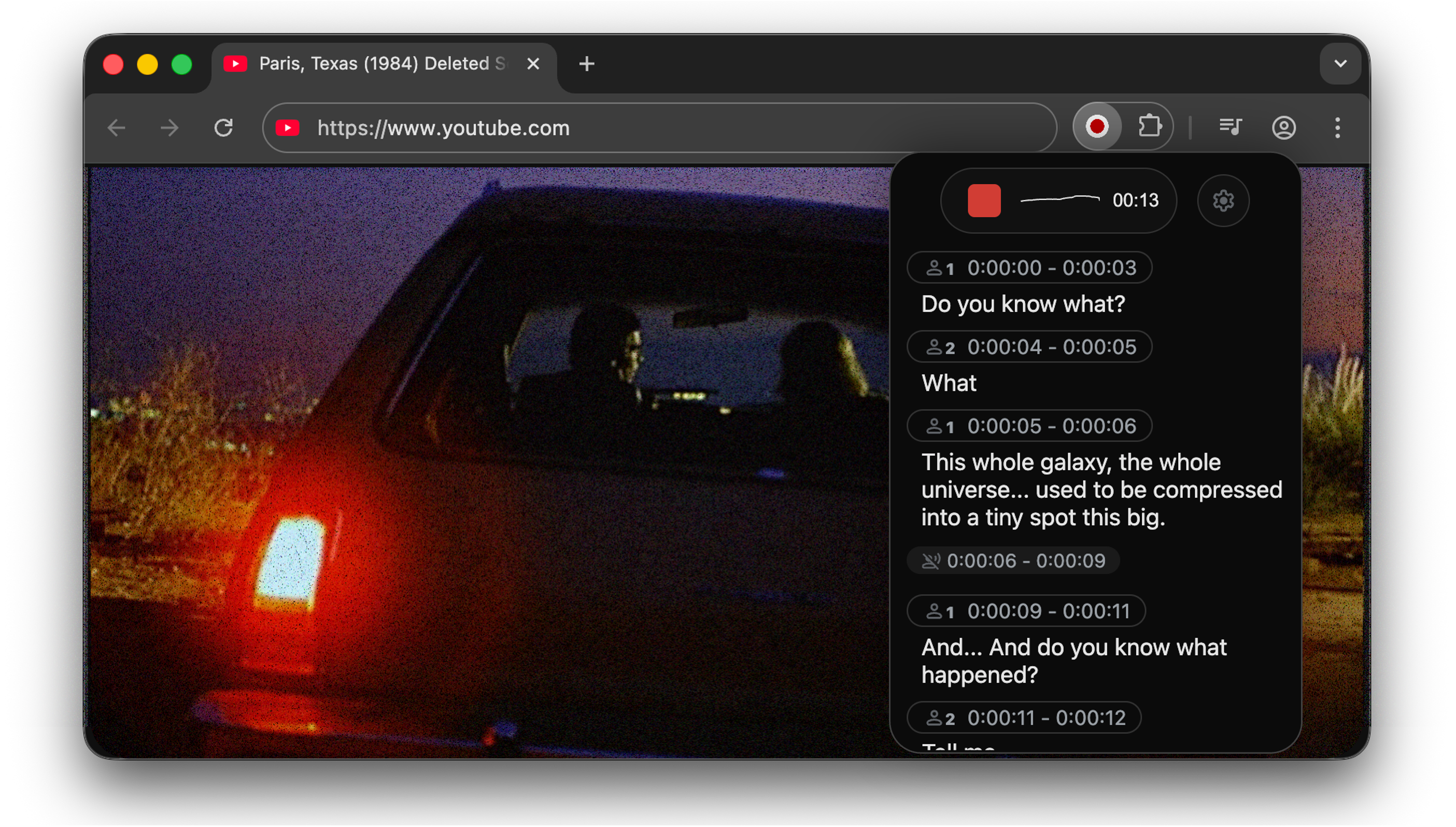
Use it to capture audio from web pages.
Go to chrome-extension for instructions.
Optional Dependencies
| Optional | pip install |
|---|---|
| Speaker diarization | git+https://github.com/NVIDIA/NeMo.git@main#egg=nemo_toolkit[asr] |
| Apple Silicon optimizations | mlx-whisper |
| Translation | nllw |
| [Not recommanded] Speaker diarization with Diart | diart |
| [Not recommanded] Original Whisper backend | whisper |
| [Not recommanded] Improved timestamps backend | whisper-timestamped |
| OpenAI API backend | openai |
See Parameters & Configuration below on how to use them.
Usage Examples
Command-line Interface: Start the transcription server with various options:
# Large model and translate from french to danish
whisperlivekit-server --model large-v3 --language fr --target-language da

# Diarization and server listening on */80
whisperlivekit-server --host 0.0.0.0 --port 80 --model medium --diarization --language fr
Python API Integration: Check basic_server for a more complete example of how to use the functions and classes.
from whisperlivekit import TranscriptionEngine, AudioProcessor, parse_args
from fastapi import FastAPI, WebSocket, WebSocketDisconnect
from fastapi.responses import HTMLResponse
from contextlib import asynccontextmanager
import asyncio

transcription_engine = None

@asynccontextmanager
async def lifespan(app: FastAPI):
    global transcription_engine
    transcription_engine = TranscriptionEngine(model="medium", diarization=True, lan="en")
    yield

app = FastAPI(lifespan=lifespan)

async def handle_websocket_results(websocket: WebSocket, results_generator):
    async for response in results_generator:
        await websocket.send_json(response)
    await websocket.send_json({"type": "ready_to_stop"})

@app.websocket("/asr")
async def websocket_endpoint(websocket: WebSocket):
    global transcription_engine

    # Create a new AudioProcessor for each connection, passing the shared engine
    audio_processor = AudioProcessor(transcription_engine=transcription_engine)
    results_generator = await audio_processor.create_tasks()
    results_task = asyncio.create_task(handle_websocket_results(websocket, results_generator))
    await websocket.accept()
    while True:
        message = await websocket.receive_bytes()
        await audio_processor.process_audio(message)
Frontend Implementation: The package includes an HTML/JavaScript implementation here. You can also import it using from whisperlivekit import get_inline_ui_html & page = get_inline_ui_html()
Parameters & Configuration
| Parameter | Description | Default |
|---|---|---|
--model |
Whisper model size. List and recommandations here | small |
--model-path |
.pt file/directory containing whisper model. Overrides --model. Recommandations here |
None |
--language |
List here. If you use auto, the model attempts to detect the language automatically, but it tends to bias towards English. |
auto |
--target-language |
If sets, translate to using NLLB. Ex: fr. 200 languages available. If you want to translate to english, you should rather use --task translate, since Whisper can do it directly. |
None |
--task |
Set to translate to translate only to english, using Whisper translation. |
transcribe |
--diarization |
Enable speaker identification | False |
--backend |
Processing backend. You can switch to faster-whisper if simulstreaming does not work correctly |
simulstreaming |
--no-vac |
Disable Voice Activity Controller | False |
--no-vad |
Disable Voice Activity Detection | False |
--warmup-file |
Audio file path for model warmup | jfk.wav |
--host |
Server host address | localhost |
--port |
Server port | 8000 |
--ssl-certfile |
Path to the SSL certificate file (for HTTPS support) | None |
--ssl-keyfile |
Path to the SSL private key file (for HTTPS support) | None |
--forwarded-allow-ips |
Ip or Ips allowed to reverse proxy the whisperlivekit-server. Supported types are IP Addresses (e.g. 127.0.0.1), IP Networks (e.g. 10.100.0.0/16), or Literals (e.g. /path/to/socket.sock) | None |
--pcm-input |
raw PCM (s16le) data is expected as input and FFmpeg will be bypassed. Frontend will use AudioWorklet instead of MediaRecorder | False |
| Translation options | Description | Default |
|---|---|---|
--nllb-backend |
transformers or ctranslate2 |
ctranslate2 |
--nllb-size |
600M or 1.3B |
600M |
| Diarization options | Description | Default |
|---|---|---|
--diarization-backend |
diart or sortformer |
sortformer |
--disable-punctuation-split |
Disable punctuation based splits. See #214 | False |
--segmentation-model |
Hugging Face model ID for Diart segmentation model. Available models | pyannote/segmentation-3.0 |
--embedding-model |
Hugging Face model ID for Diart embedding model. Available models | speechbrain/spkrec-ecapa-voxceleb |
| SimulStreaming backend options | Description | Default |
|---|---|---|
--disable-fast-encoder |
Disable Faster Whisper or MLX Whisper backends for the encoder (if installed). Inference can be slower but helpful when GPU memory is limited | False |
--custom-alignment-heads |
Use your own alignment heads, useful when --model-dir is used |
None |
--frame-threshold |
AlignAtt frame threshold (lower = faster, higher = more accurate) | 25 |
--beams |
Number of beams for beam search (1 = greedy decoding) | 1 |
--decoder |
Force decoder type (beam or greedy) |
auto |
--audio-max-len |
Maximum audio buffer length (seconds) | 30.0 |
--audio-min-len |
Minimum audio length to process (seconds) | 0.0 |
--cif-ckpt-path |
Path to CIF model for word boundary detection | None |
--never-fire |
Never truncate incomplete words | False |
--init-prompt |
Initial prompt for the model | None |
--static-init-prompt |
Static prompt that doesn't scroll | None |
--max-context-tokens |
Maximum context tokens | None |
--preload-model-count |
Optional. Number of models to preload in memory to speed up loading (set up to the expected number of concurrent users) | 1 |
| WhisperStreaming backend options | Description | Default |
|---|---|---|
--confidence-validation |
Use confidence scores for faster validation | False |
--buffer_trimming |
Buffer trimming strategy (sentence or segment) |
segment |
For diarization using Diart, you need to accept user conditions here for the
pyannote/segmentationmodel, here for thepyannote/segmentation-3.0model and here for thepyannote/embeddingmodel. Then, login to HuggingFace:huggingface-cli login
🚀 Deployment Guide
To deploy WhisperLiveKit in production:
-
Server Setup: Install production ASGI server & launch with multiple workers
pip install uvicorn gunicorn gunicorn -k uvicorn.workers.UvicornWorker -w 4 your_app:app -
Frontend: Host your customized version of the
htmlexample & ensure WebSocket connection points correctly -
Nginx Configuration (recommended for production):
server { listen 80; server_name your-domain.com; location / { proxy_pass http://localhost:8000; proxy_set_header Upgrade $http_upgrade; proxy_set_header Connection "upgrade"; proxy_set_header Host $host; }} -
HTTPS Support: For secure deployments, use "wss://" instead of "ws://" in WebSocket URL
🐋 Docker
Deploy the application easily using Docker with GPU or CPU support.
Prerequisites
- Docker installed on your system
- For GPU support: NVIDIA Docker runtime installed
Quick Start
With GPU acceleration (recommended):
docker build -t wlk .
docker run --gpus all -p 8000:8000 --name wlk wlk
CPU only:
docker build -f Dockerfile.cpu -t wlk .
docker run -p 8000:8000 --name wlk wlk
Advanced Usage
Custom configuration:
# Example with custom model and language
docker run --gpus all -p 8000:8000 --name wlk wlk --model large-v3 --language fr
Memory Requirements
- Large models: Ensure your Docker runtime has sufficient memory allocated
Customization
--build-argOptions:EXTRAS="whisper-timestamped"- Add extras to the image's installation (no spaces). Remember to set necessary container options!HF_PRECACHE_DIR="./.cache/"- Pre-load a model cache for faster first-time startHF_TKN_FILE="./token"- Add your Hugging Face Hub access token to download gated models
🔮 Use Cases
Capture discussions in real-time for meeting transcription, help hearing-impaired users follow conversations through accessibility tools, transcribe podcasts or videos automatically for content creation, transcribe support calls with speaker identification for customer service...